Eyes on the Exceptional with Lawrence van Hagen
Style and substance are a rare combination, and Lawrence van Hagen — curator, connector, and founder of LVH Art — has mastered it. From a hanok in Seoul to a raw Mayfair penthouse, he curates experiences that recalibrate how we look. Here, he talks process, pulse and what’s next.
The first work - or moment - that challenged your perspective.
A specific exhibition rather than a single work comes to mind: Barnett Newman at Tate Modern (2002–03). Only around 120 of his paintings exist, so being surrounded by so many in one space felt incredibly rare. Newman’s narrow stripes—his “zips”—carry an astonishing charge and taught me the power of a seemingly simple line: how minimal means can deeply impress. Many consider the canvases repetitive, but time with them reveals how distinctly each one breathes. That show taught me to slow down, to look longer, and to understand how less can be more.
From rare works in Seoul to canvases suspended in a construction site in London, your curation moves seamlessly between classic and raw. What guides your curation?
I start by asking how to push against the traditional white-wall model while staying honest to time and place. Double Take explored where our relationship with technology is headed; many works asked whether what you were seeing was made by hand or via digital means. That need to look again—twice—gave the show its title.
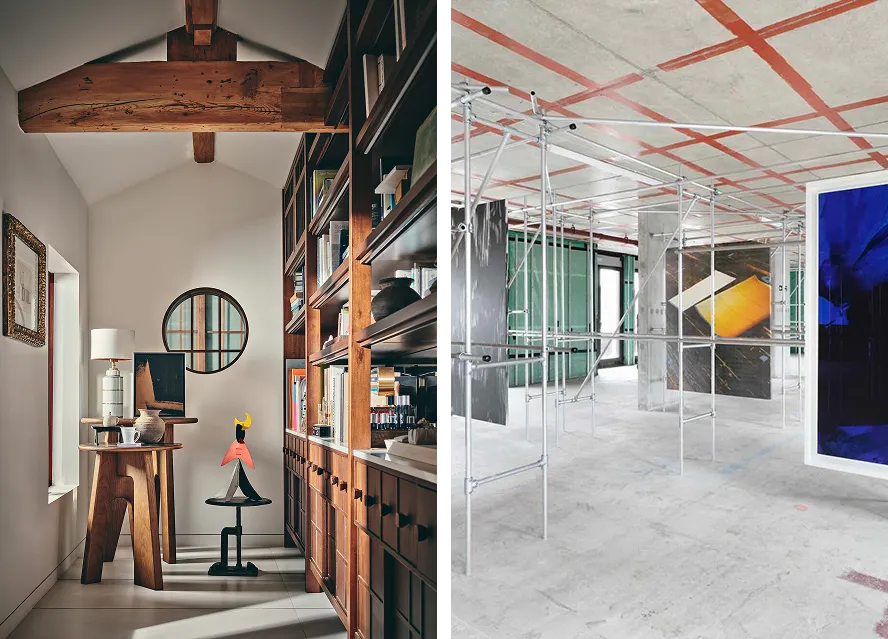
Curation is about the larger composition: site, artists, individual works, and timing. In Seoul, the setting—a historic hanok—called for focus and intimacy, so 12 Masters presented twelve compact works by post-war and contemporary heavyweights. The clarity of the title felt right for the space. In contrast, Mayfair’s still-under-construction penthouse invited themes of repetition, perception, and artifice; with the building’s bones exposed, the dialogue with architecture felt explicit. The openness also suited a larger number of works at larger scale.
For my upcoming exhibition in London, Urban Dwellers, I’m spotlighting younger artists. There are too few platforms for them in London—especially during Frieze Week—so the show aims to close that gap and bring fresh voices to the fore.
Your knowledge of art is expansive, but your taste feels instinctive. Where do you scout new or under-the-radar talent—from someone’s living room to institutional archives?
Everywhere: printed magazines, social feeds, grad shows, studio visits, collectors’ homes, and, of course, fairs—large and small. Word of mouth still matters; conversations with artists, gallerists, and collectors surface signals early. Staying properly informed takes time and concentration, which is where an advisor earns their keep. My job is to be in the right rooms and the right conversations so clients don’t need to be.
How do you balance trust and taste in your advisory work?
I begin by listening. We map a client’s instincts first, then refine: which artists to acquire now, which to keep on the radar, which specific works strengthen the arc of a collection. I recommend artists I collect myself—skin in the game builds trust—but the priority is resonance at the right price. The best collections feel unmistakably personal; my role is to make that clarity visible.
What are the biggest shifts you're observing in today’s market—from geography to generational taste? What excites you most?
Collectors are gravitating back to Minimalism and Conceptual Art—a natural counter to image overload and a saturated market. Geographically, the centre of gravity is widening: the Middle East is accelerating (the Islamic Arts Biennale in Jeddah was impressive; Art Basel’s move into Doha signals momentum), and India’s appetite continues to expand. Fairs will remain important, but fewer will operate as truly global hubs; many are becoming more locally tuned.
You’ve sourced extraordinary works. Can you share a few highlights that now live in client homes—or your own?
Across exhibitions and placements—and on my own walls—there are works by Andy Warhol, Roy Lichtenstein, Robert Rauschenberg, Tracey Emin, Jenny Saville, Cecily Brown, and even Brancusi. I’m privileged to have lived with and placed works like these. It’s a mix of established voices and those I believe are decisively next; I’ve been collecting for years, long before advising, and that commitment tends to reassure clients that I’m personally invested in the discourse.
